Chapter 4: Pollywogs
By the time I suggested to Charlotte that we pull the Airstream to the Grand Canyon for an October getaway, it felt like a perfectly natural thing to do. She was coming over often, and we had found a rhythm. Mornings meant coffee on the porch and the quiet clank of tools in the shop. Afternoons she practiced welding, or she worked on her idea for the therapy center, scribbling notes in a yellow legal pad. In the evening I would cook, or we would drive into town for Italian or Tex-Mex.
I had begun to watch her – trying to understand her better. I noticed she sometimes went very still – her face taking on a faraway look, as if thinking more deeply than I could follow. I discovered that she liked to see everything going on around her, so in restaurants she sat with her back to the wall. One thing was most striking of all: she didn’t like closed doors. I got a little tired of opening them to circulate air, but mostly I let it go.
And why the Grand Canyon? I have a story about that.
Twelve years earlier, my climbing friend Lyn got a permit for a backcountry canyon trip: Grandview Point to South Kaibab, about twenty-nine miles. We flew to Phoenix, got a cheap hotel in Flagstaff, then in morning caught a cab from one of the South Rim lodges to the trailhead. It was a chilly April morning, but the skies were clear and the sun bright.
We shouldered our packs, extended our trekking poles, and started down the rocky trail. After I had hiked maybe two hundred yards, I stopped. I sat on a rock, leaned back to take some of my pack’s weight off my shoulders, and looked around. What I saw was so unlike anything else I had encountered that it nearly left me speechless.
I saw rocks seemingly burnt red by the sun. Wind-carved towers rising from broken cliffs. Deep gorges falling away into shadows. And a sky so blue it seemed unnatural.
The scale was incomprehensible. It was completely different from what one sees from the rim. Now, the canyon was not just deep. It had depth. Scale.
But what really got me was the silence.
Not quiet. Silence. The kind that doesn't just muffle noise but absorbs it. Swallows it. It makes you realize how much noise you carry in your head all the time.
When I finally caught up to Lyn, he too had found a rock to sit on. He asked me what I thought. I poked the ground with my poles and watched a fence lizard scamper along a juniper branch. Then I said, “Lyn, I think I’m home.”
I’ve gone back every year since. Sometimes twice. So of course I took Charlotte. Of course, I wanted her to see it the way I first did. Of course, I thought this was going to bring us closer.
And of course, that did not happen.
At first, all seemed well. We spent two days on the road, listening to the tires hum across the vast flatness of West Texas. We stopped at a roadside stand in Pie Town, New Mexico. I bought two slices – apple for her, pumpkin for me. We ate them with plastic forks in the parking lot.
Charlotte navigated while I drove. We listened to Emmylou Harris and Neko Case and talked about nothing important. We overnighted on BLM land in Red Rocks Park, the truck and trailer a few yards off the road, not another vehicle in sight. We burned pine firewood until late into the night, then drank our morning coffee watching the sun hit the crimson rocks.
By late afternoon of the second day, we were there – Mather Campground on the South Rim. Mather Campground, and its preposterously big campsites, its cinnamon-barked Ponderosa pine, and the constant attention of ravens. Little black dinosaurs – you could see it in the way they walked. No, strutted. Mean, smart, and opportunistic as hell. They could disassemble a campsite in five minutes.
At Hopi House – a place for Native American artisans to display their work – I noticed Charlotte admiring a small silver brooch set with turquoise. When she walked away to look at something else, I bought it for her. “That’s too much,” she said that evening when I produced it. I told her it would remind her of Arizona. And maybe of me.
At the bookstore she purchased a copy of my favorite book, Over the Edge: Death in the Grand Canyon. I had once met one of the co-authors. She read the first few chapters that night at the dinette, increasingly horrified. One story described two hikers who tried to speed-hike the same route that Lyn and I had taken. They misread the map – thirty-two miles, not twenty. It was a hot June and they had half the water they needed. On the second day they split up – the man too exhausted to continue, the woman determined to get to Phantom Ranch at the bottom of the canyon and get help.
The next day searchers found her dead, huddled in a fetal position stuck between cliffs when she left the trail to take what looked like a shortcut. Her companion – who finally made it out – had slept the previous night in a motel, so confident she’d made it to safety he didn’t bother to call the backcountry office to ask about her.
What Charlotte couldn’t get over was that early on that second day, they had found a pool of water.
The man refused to drink it.
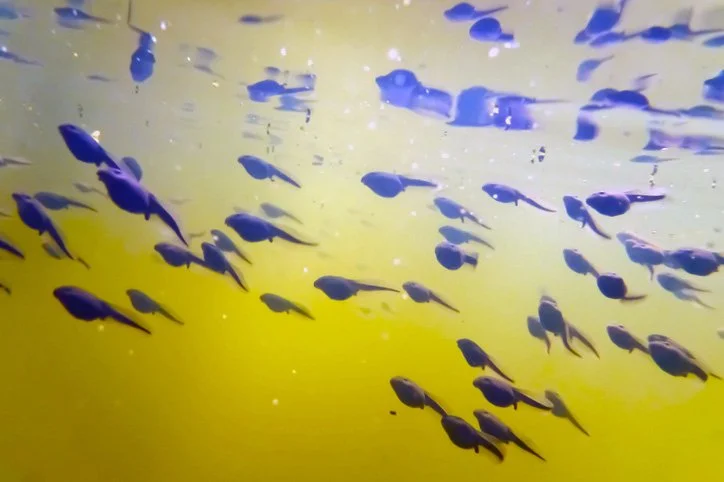
There were pollywogs in it.
Pollywogs.
“So…people die here?” she asked. “Pretty often,” I had to admit. I had almost died here once myself – a stumble, a head laceration, a concussion, a helicopter ride out. I decided not to bring this up.
Charlotte frowned. “And you brought me here…like a date?”
“Well…yeah.”
She turned a page and kept reading. “You’re weird,” I heard her mutter.
The next day we did an easy hike on the Bright Angel Trail, deliberately timing it so we came up and out in the dark, looking up at The Milky Way arching overhead like a garden hose spraying stars. “I’ve never seen so many stars,” Charlotte said.
I felt like I'd given her a gift.
That evening, I grilled tenderloin steaks directly on the coals of the campfire. Just meat on embers.
Charlotte watched, skeptical.
"Won't that ruin them?"
"Nope. Watch."
I pulled them off after four minutes per side. Brushed off the ash. Sliced one open. It was a perfect medium-rare.
"Oh my gosh," she said, tasting it.
"Right?"
The next day, feeling confident, we hiked the South Kaibab Trail. But Charlotte began to struggle not long after we cleared the first switchbacks. The altitude was hitting. After a mile and a half, we stopped at Oo-Ah Point, but the sweeping view was lost on her. She was breathing hard. “I need to rest,” she said.
“You’ll be fine,” I said. “It’s the elevation.” We kept going.
Somewhere above Cedar Ridge, the sky changed – that fast desert shift from bright to ominous. The wind came first, then rain. Big cold drops that smacked into the dust. The trail became slick. Charlotte slowed. I turned and looked back at her.
“You okay?”
“I’m tired.”
Twenty minutes later she stopped. “Thomas, I need to eat something.”
I reached into my pack. Then I realized with a start that I didn’t have our snacks. I had taken the bag I keep them in out of the pack after our previous hike – to replenish it – and then forgotten it. So no Goldfish crackers. No Snickers bars. No Liquid IV packets I always carry. The things that bring a person back when they’re fading. “I don’t have anything,” I said. “It’s back in the trailer.”
She stared at me. “You’re joking.” She sat on a rock and put her head in her hands.
Here was the rub: I knew better. I had spent the previous two summers working as a volunteer in the canyon with PSAR – Preventative Search and Rescue. My job was to make sure people didn’t get into the kind of trouble Charlotte was in right now. And I had made one of the most basic mistakes in the book.
The rain worsened. Each time we crossed the ridge crest, the weather changed – blasting wind on one side, merciful calm on the other. Charlotte bonked. Hard. Stumbling, lightheaded, miserable. “Just a little further,” I kept saying. Then she tripped. Went down on one knee. Scraped it raw. “So, this is your goddamn happy place?” she muttered.
By the time we clawed our way back to the rim, we were drenched, exhausted, and mad as hell at each other. Back at the Airstream, I heated tomato soup. Neither of us spoke. Charlotte winced each time she shifted her weight.
“I’m sorry,” I said finally.
She looked at me.
“I should have double-checked the pack,” I said.
“Yeah. You should have.” Her voice was flat. Not angry. Just done. With me.
***
I remember the drive home clearly. We talked about gas stations and weather and the merits of roadside kolaches. But we didn’t talk about the canyon. And we definitely didn’t sing any duets.
At a rest stop on Interstate 35, a trucker pointed at the Airstream. “I bet you’re calling about that tire,” he said. In the right wheel well, the remnants of the front tire barely clung to the rim. Shredded. That explained the rough pull for the past twenty miles. By the time Charlotte came out of the restroom, I had the jack pumping. In a quarter hour, I was finished and soaked with sweat.
Back on the highway, I set the cruise to fifty-five. We passed an occasional flash of cream from an exposed limestone formation, or splashes of green against the tawny grassland. I put my right hand to my cheek and scratched it, then put it back on the sun-warmed steering wheel. “Charlotte,” I said finally, keeping my eyes on the road. “I’m sorry about how things turned out. I’m sorry about that hike.”
She was looking out the passenger window. “It’s OK,” she said.
“No – it is not OK,” I replied. “That whole fiasco was my fault. And it wasn’t just the fact I forgot the Goldfish and Snickers. I should’ve been paying attention to you, not the stupid story in my head. I tried to make you see that canyon the way I do.”
She leaned back in her seat, letting the words settle. Her window was cracked open, and the wind lifted a strand of hair across her cheek that she didn’t bother brushing aside. Something about that made her look younger and older at the same time.
“Charlotte?” I asked. She brushed the hair away and rolled the window up. “Yes?”
I exhaled. “I just want you to know – I understand that what I did made for a thoroughly miserable day.”
She turned from the window and looked at me. “That means a lot,” she said. “I wanted to keep up. I tried. It just felt like you had a goal – a goal that didn’t include me.”
“You’re probably right,” I said. “But there is an odd thing about the canyon. It’s not a mountain. There’s no summit. In the Grand Canyon, the point is to be present. To be in the moment. There is no ‘there’ to reach. There is only ‘here.’”
“You were the one who was present,” I said. “Not me. I was trying to get somewhere.”
Her hand reached out to my knee. “It’s all right,” she said. “We’re all right.”
I took one hand off the wheel and put it atop hers.
***
A few months later, on a cold December evening, Charlotte texted me from her place. “Would you like to see a movie tonight?”
“Sure,” I texted back. “What time? What movie? What can I bring?”
A moment passed. Then: “Six. Arrival. Bring popcorn. I’ll order pizza.”
Charlotte lived about fifteen minutes from my place, in a trim blue rambler. Before I could knock, the door opened. She was wearing a soft slate-blue knit that hung loose on her, and a black woolen vest. Her hair was in a low, messy bun, and I noticed the turquoise brooch from Hopi House clipped to the vest. “Hello,” she said, smiling. “The Pizza de Roma guy was just here.”
As I stepped inside, she brushed a quick kiss against my cheek. It was soft and cool yet somehow loaded with voltage. She had a small Christmas tree in one corner, bright colored lights neatly arranged on its branches.
We ate standing. I was chewing on a wedge of margherita when a legal pad on the counter caught my eye. “Burton Road Therapy Center” was written at the top in her precise longhand. Below that: Find property/barn. Horse? Maybe two. Advertise. Scribbled at the bottom: Twenty-six thousand dollars.
The donation I had arranged.
Charlotte noticed me reading it. “Any thoughts?” she asked. I rubbed my chin. “Finding the property is the biggest hurdle.” She nodded. “It is. But amazingly – I have money to get started. It came through a charitable group that supports mental health initiatives. I don’t even know how they heard about me.”
My face felt hot. I debated telling her but tamped it down.
I took the wine glasses to the coffee table and sat on the dark blue couch. Charlotte followed, picked up the remote. I took my shoes off and propped my stockinged feet on the table. “Do you mind?” I asked. She shook her head. I shifted until our hips touched. She leaned into me.
The movie started. A linguist makes contact with two seven-limbed aliens. Ten minutes in, my phone chimed. “It’s Peter,” I said – my slightly goofy local friend. I handed her the phone. “Text him back – in French. Tell him we’re under the comforter and I’m running my hands all over your body. That’ll fix him.”
Charlotte smirked and began typing. “Coucou Peter. On regarde un film sous la couverture. Thomas ne peut pas garder ses mains pour lui.”
I laughed. “The poor guy is probably about to faint.”
The movie played on. Louise’s visions of her daughter are not flashbacks but flash-forwards – she is seeing her life ahead. Charlotte gasped softly and put her hand to her mouth. “She’s experiencing events that haven’t happened yet.”
In the closing scene, Banks realizes she will have a child despite knowing the child will die from an incurable disease. We sat in silence as the credits rolled.
Charlotte cleared her throat. “Something on your mind?” I asked.
“Yes,” she said. “I have a question for you. If you had something good, but discovered it wouldn’t stay good forever – like in the movie – what would you do? Would you keep it, or let it go?”
I got up and went into the kitchen, poured popcorn into a saucepan, and turned on the heat. When the popping stopped, I tipped the white kernels into a bowl and sprinkled them with truffle oil and salt. When I carried the bowl to the sofa, Charlotte lifted the edge of the comforter she had thrown over her knees. I slipped in beside her.
“Well?” she asked.
“One follow-up,” I said. “Tell me – how good is this thing you’re talking about?”
She came closer and her head fell gently against my shoulder. Her hair smelled of lavender.
“It’s very good,” she said.
I chewed a kernel. She turned her face up to mine.
“Sometimes you have to accept the bad to keep the good,” I said. “I’d stay.”
“Good,” she said. I felt her move on the cushion, closer to me. I put an arm around her shoulders and pulled her even closer. Her face turned up to mine, her features partially shaded but that didn’t matter because I already had them memorized.
I kissed her forehead. Then her eyes. Then her lips.
I didn’t know why, but the lights strung on the tree seemed to glow more brightly. I looked at them for a moment, then the words came out. “Come to my place,” I said. “Move in. With me. Please.”
She sat straight up. “What did you say?”
“Sorry – I didn’t mean to just blurt that out,” I said. But look – I’m here a lot; you’re at my place a lot more. Who are we kidding?”
The popcorn was gone.
“Oh Thomas…you’re serious about this, aren’t you?” Her voice was low. We were warm under the comforter. “I am,” I said. “Completely serious.” My heart was pounding. Charlotte’s hand ran along my thigh and gave it a squeeze. “Then I guess we’d better start thinking about making room for me there.”
I leaned over and kissed her, then pulled away a few inches. “I hoped you would say that.”
She picked up the remote and shut the television off. “Where to start?” she asked.
For a moment we were still. Then we moved. Quickly.
By the time we reached the bedroom our clothes were mostly off, my belt buckle clattering on the floor, her blouse fluttering down. No words now. Just hands and quiet sounds and warmth and soft skin and longing. Two people creating their own gravity.
Afterward, her breath was soft and warm in my ear. “Thomas,” she said quietly. “Thank you.”
There was nothing for me to say. The Texas wind pressed against the windows, and somewhere outside a coyote called once, then was silent.
________________________________________________________________