Chapter 5: The Weather Channel
Two weeks before the party, Charlotte and I were at the kitchen table with legal pads and cups of coffee, pretending the guest list mattered more than a tornado watch on the Weather Channel. The coffee had gone cold. I stepped outside to look around. Thin cumulus clouds were blowing in from the southwest, with darker clouds below. The wind seemed confused – wafting one way, then another. The air was thick and moist, and my shirt stuck to my back.
Charlotte came out and stood beside me. “Do you think one will hit us?” she asked nervously.
“Dunno,” I said. “Hope not.”
We went back into the kitchen and tried to focus. “Alright,” Charlotte said. “We can each invite thirty people. Realistically, maybe twenty will come.”
I nodded. “We’ll ask people to RSVP,” I said. “And assume a few will ignore that entirely.”
We began to write. “Who do you have so far?” I asked after a minute, glancing at the television. “Well, my parents, if you don’t mind,” Charlotte said. “And Celeste from Austin Community. You haven’t met her – we were in a photography class together.”
It was starting to seem that Charlotte was one surprise after another. “When did you take a photography class?” I asked. “This is news to me.”
She looked up from her notes. “Well, it was just a few mornings a week, plus some online time,” she said. “You know I don’t come over here every day.”
This was true. “I suppose,” I said. “I’m just curious – what do you shoot with?” I did a lot of photography.
“Same thing as you,” she said. “A Fuji APS-C camera. You said you liked yours and that was good enough for me. I bought mine on eBay.”
“Oh!” I said. “How did you know which one to get?”
Charlotte chewed the end of her pen and looked at me. “It was easy,” she said. “Your camera bag is in your office. I looked.”
I wasn’t sure I liked that but wasn’t sure why I should care. “You could have asked,” I said, trying not to sound cross. “I would have been happy to show you.”
She looked at her pad. “Sorry,” she said. “You were out and I just decided to take a quick look.”
“It’s okay,” I said. “You didn’t steal anything. Did you?” I tried to make the question sound funny.
Then my eyes went back to the television. A red and purple band looked like it was about 60 miles west of us and coming our way. I’d been through a few tornado near-misses since moving to Texas, and I didn’t like them. Tornadoes were kind of a childhood phobia growing up in Portland. Not because we had them, but because of watching The Wizard of Oz. But here in Texas, they were real. And right now, entirely too real. I went back to my list and ticked off a few names. “And Peter,” I said. “He’ll come alone.”
“We can put him to work, then,” Charlotte said. “He might enjoy helping with the food.”
I snorted. “You mean helping himself to more food.”
Another look at the television. An orange band of clouds coming out of the west had coalesced into a threatening blob of red. I thought I could make out a telltale hook of a tornado forming. Maybe forty miles away. If it was moving at thirty miles per hour, that gave us a little more than an hour – or less. I snapped my laptop shut. “Charlotte,” I said. “Time to move.” She looked at me, then the television. Her eyes widened. “You close up the house,” I said. “Get flashlights and candles. I’ll get the generator ready.”
I stood and strode to the door. “Be careful,” she said behind me.
Outside, I locked the shop, then wrestled the generator out of the barn. I topped off the gas and punched the starter button. The big machine coughed once, coughed again, and barked to life with a puff of grey smoke. It was crude, loud, and comforting. I shut it off, then walked the property to secure any loose thing I could find. The trailer worried me, but Airstreams were good at shrugging off wind.
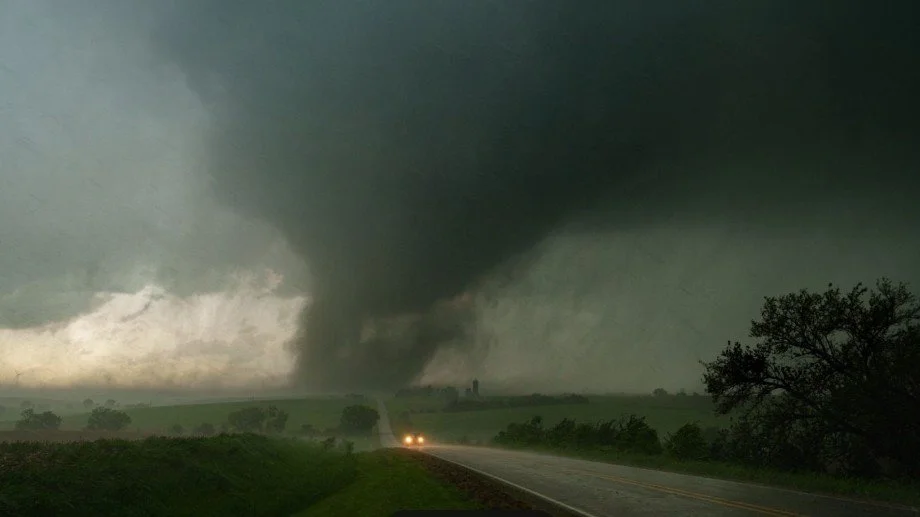
A gust whistled past, and I looked to the west. I’d never seen one before, but I knew immediately that I was looking at a supercell. It consisted of a flat, shallow disc of grey clouds, with a fringe of lighter clouds dropping from the disc like a ragged curtain. I estimated it to be three miles across and could see stabs of lightning shooting down from and hitting the ground.
For a moment I was mesmerized. Then the first fat drops hit the ground – hard enough to lift dust. I ran for the house through what almost immediately became pelting rain, and Charlotte opened the door before I reached it.
I peeled off my wet T-shirt in the entry, then grabbed a dry one. “Main floor bathroom,” I said quickly. “No windows. Let’s go.” I took her hand and pulled her down the hallway. A flash of white light came through a window, then thunder hit the house like a blunt instrument. I felt Charlotte flinch.
The bathroom should be sturdy enough in case we take a hit, I thought. But I wasn’t entirely confident about that and vowed to dig a shelter once this was over. Maybe go under the foundation on the east side – away from the prevailing storm directions.
But that had to wait. I pulled Charlotte into the bathroom with me. “Here – sit in the corner,” I said. Then I grabbed all the towels on the rack and heaped them over her. When she looked at me, I said, “In case glass breaks.” But if glass was breaking in the bathroom, we had a lot more serious problems than that.
I sat on the floor next to Charlotte and pressed her into the corner. She was clutching the towels in a clump – I grabbed them and tried to form a rough blanket over her arms and neck. Not over her head – she hated not being able to see. I would do that later if I needed to.
The storm was loud outside the house. I tried to triangulate where it was hitting the hardest, like one might do if an intruder were rattling different doors, trying to find the one that was unlocked. Right now, it seemed to be the northwest corner taking the brunt. The kitchen side.
The house trembled under the onslaught, and something slammed against the siding hard enough to rattle the door. Charlotte leaned into me and I could feel her trembling. “This is terrifying,” she whispered. “I’ve never been through anything like this.”
Then the power died – the lights went out and the bathroom fan coasted to a stop. For a long moment there was nothing but wind – and that strange, animal roar a storm makes when it sits on top of you. Somewhere in the house, glass shattered – the sound of fragments skittering across tile. “Kitchen window,” I said, though I couldn’t be sure. I turned on a flashlight, and its beam caught motes of dust shaken from the walls. I was convinced the house could not possibly take more.
I wrapped my arm around Charlotte’s shoulders. She pressed close, fingers tightening around my forearm. Then she looked up at me, and her face caught the flashlight beam. It was a mask of fear. I thought she was going to say goodbye, that she loved me, that she was sorry. Or something like that. Instead, “Maybe we should play cards to pass the time.” I looked at her incredulously. “What?” The house shuddered again. For a heartbeat I thought: This could be it. Or it could just be a story we get to tell. I hoped for the latter.
Still. “Cards?” I didn’t even have a deck in the house.
That was when the roar of the storm became more of a demented shriek. Bits and pieces of I had no idea what was slamming into the side of the house like machine gun fire. Charlotte shouldered herself under my arm, put her hands over her ears, and began to weep with terror. I was about to do the same.
And then everything, somehow, did…what? I couldn’t tell. But the storm seemed to thin. Not a silence – more like a flattening, as the storm’s roar smeared into a single long note. The darkness now felt less like darkness and more like absence. After another 10 minutes, it grew quiet – the rain was falling loudly but compared to the earlier wind it seemed inaudible. I exhaled. “It’s gone,” I said. “I think we made it.” I stood up and helped Charlotte to her feet, then opened the bathroom door.
We walked carefully to the kitchen. Broken shards of glass glinted on the floor. Now the storm was moving east. I could hear it in the rain – less fury, more of a steady insistence – and in the lightning, now sulking toward the horizon. The sky beyond the broken window still glowed a sickly yellow.
A branch the size of a small tree jutted through the shattered glass, half in, half out, as if the house had tried to swallow it. “Jesus,” I said.
Charlotte stared. “How did we sleep through this?” she asked. “It looks like a war zone.”
I looked at her. “We didn’t sleep through it,” I said.
“We didn’t?” she asked, sounding surprise.
“No,” I said firmly. “We were in the bathroom. In the corner. You suggested we play cards to pass the time.”
“I did not.”
“You did.”
She frowned at me. “OK. If you say so.” The tone was wrong. Not dismissive, just odd.
I started to answer, but she stepped closer to the shattered window. “Stop…” I tried to say. Too late. Her foot slid on rainwater. She caught herself on the counter with her left hand. But her right forearm slid across a broken glass shard. I heard a thin, sharp inhale from her. Blood spread down her forearm almost immediately.
“Don’t move,” I said. I wrapped a dish towel tight around her forearm and lifted her hand toward her shoulder. In the dim light a blotch on the towel spread and turned dark.
“It hurts,” she whispered. “A lot.”
“I believe you. Keep pressure.”
I got her seated, then walked quickly to the garage to grab the first aid kit. Once back with her, I took a closer look at the wound. It was not trivial, but it was manageable. No artery damage. I got another clean towel, had her hold pressure for a moment, then took it off. “This’ll sting,” I said, as I cleaned around the wound with a Betadine wipe. Then I pulled the cut together with butterfly bandages, four in a neat row. She watched every movement. “You’re good at this,” she said softly. “Thank you for taking such good care of me.”
I glanced at her.
“You don’t have to lay it on quite so thick,” I said. I almost laughed, although of course I liked being seen as the hero.
“I’m sorry,” she murmured. “I’m not always sure how much is enough.”
“Well,” I said. “I appreciate being told I’m good at something. But when you say it three times it loses some impact.”
She had. First, in the bathroom, and then right after.
Charlotte looked at me and nodded.
I pulled on a raincoat and went outside to start the generator. Lights came on. The Weather Channel replayed the radar loop, the hook echo sliding north of us. “A mile away,” I said. Charlotte watched the screen, her bandaged arm propped on a pillow. “We were smart to shelter in the bathroom,” she said. “Your quick thinking probably kept us safe.”
I turned to her. “You said that earlier.”
Her brow furrowed. “I did?”
“Pretty close.”
I gave her two Tylenol and checked the bandages. No new bleeding. She curled up in the recliner under a blanket, drifting in and out of exhausted sleep while wind threaded through the broken window frame.
When she seemed comfortable, I brought a trash can inside and spent an hour picking up bits of glass. Then I woke Charlotte, and we ate scrambled eggs. We drove to urgent care, where it was two hours before a tired-looking physician’s assistant cleaned the wound, placed five stitches, and nodded approvingly at the butterfly closures. “Good work,” he said. “You got her here in time. Not much risk of infection. But we’ll want to watch this.”
On the way home, Charlotte cradled her arm and watched the debris along the road slide past her view. Branches, metal, something that looked like a tractor-shed door. “That was awful,” she said. “
“We got through it,” I said.
“We did.” A pause. “Thank you for taking us into the bathroom. For keeping us safe.”
“You remember that?”
A small hesitation. “I remember you saying we went in there,” she said. “I know that’s where we were. The rest is… outlines.” That was all. Back home, I settled her on the couch, tucked a pillow under her arm, and started a rom-com. She closed her eyes.
I walked back to the bathroom. The corner where we’d crouched was exactly as we’d left it. Towels on the floor, flashlight tipped over, a faint scuff on the wall. I tried to recall the moment. The tilt of the house, the sound of shattering glass, her fingers gripping my arm in the dark. I could feel it immediately.
But I wasn’t sure she did. Not quite. Not the way most people would.
When I returned to the living room, Charlotte was awake, a blanket around her shoulders, stitched arm resting on a pillow. “How does it look out there?” she asked.
“Messy,” I said. “New glass comes in a few days. Rest of the house is fine. A few missing shingles, and we lost an apple tree.”
She gave me a long look. “You remember it all better than I do. I feel badly about that – I really do want to see things more like you do. I think that would be good for us. Don’t you?”
I opened my mouth to speak, then closed it. Then I tried again.
“Yes,” I said. “I do.”
We learned later that the tornado had touched down in an open field a mile away, hopped into the air, sailed over and mussed the hair of three houses and a mini-mall, then spun itself apart. An F2. Wind speeds of 115 miles per hour.
That was close.
______________________________________________________________